FWFreight is your premier choice for freight shipping to Italy, providing an unparalleled suite of services to support your logistics needs. We understand the importance of time, cost and reliability in any successful business transaction. Therefore, we've curated a comprehensive range of solutions that cater to diverse shipping needs, whether via sea, air, rail, or truck. Our proficiency extends beyond simply delivering your goods. We also provide effective forwarding services to ensure smooth import to Italy from other countries. With FWFreight, you can expect seamless international shipping to Italy from other countries, backed by an industry-leading commitment to excellence.
From a service perspective, our company stands atop the logistics industry by offering world-class customer experience. We are deeply rooted in our commitment to developing flexible solutions that adapt to the unique needs of our diverse clientele, from domestic exporters to global importers. Our tailored solutions are brought to life by a dedicated team that goes above and beyond to warrant optimal results. We believe each shipment holds much more than just the material value, it holds the potential for a successful business transaction, the growth of a company, and the satisfaction of a client. Therefore, we position our shipping company as a strategic partner who delivers on its promise to ensure that you have the best service experience, regardless of the scale, size or complexity of your logistics requirements.
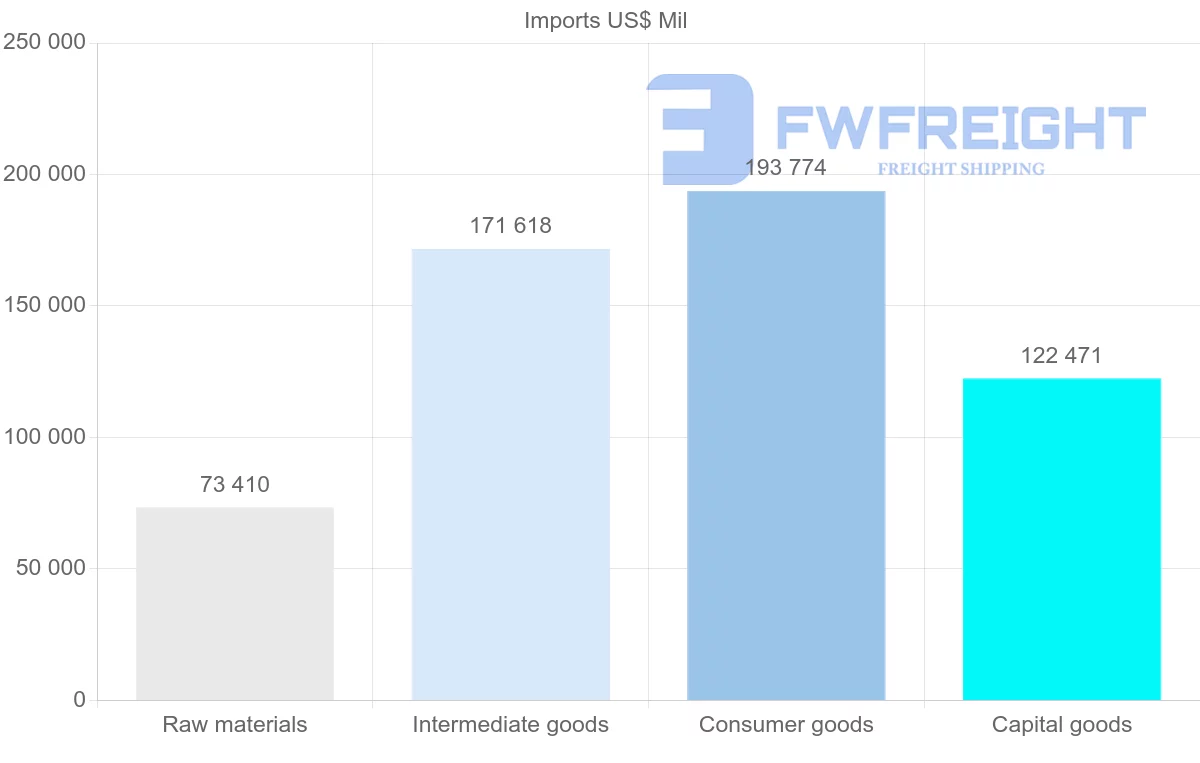 The graph presents a consolidated view of the distribution of Italy's imports across various product categories. The categories included Raw Materials, Intermediate Goods, Consumer Goods, and Capital Goods. It depicts their respective import values (in mil US dollars) and their percentage contribution to the total import volume. Raw Materials which encompass unprocessed or primary products utilized in manufacturing, logged an import value of US$73,410 million, accounting for 12.92% of the total import volume. Intermediate Goods, which refer to partially finished products used in the production of final goods, showed an import value of US$171,618 million, making up 30.20% of the total volume.
Consumer Goods, encompassing finished products that are used by consumers, recorded the highest import value of US$193,774 million, holding the largest share at 34.10% of the total import volume. This signifies that a significant proportion of Italy's imports are ready-to-use goods meant for direct consumption. Finally, Capital Goods - the tools, machinery, and equipment used in the production of other goods and services - had an import value of US$122,471 million, contributing 21.55% to the total import volume. This substantial share suggests a notable level of investment in machinery and technology for production processes. Hence, the graph effectively illustrates how these four product categories each contribute to Italy's total import figures, highlighting the significant weight of consumer goods.
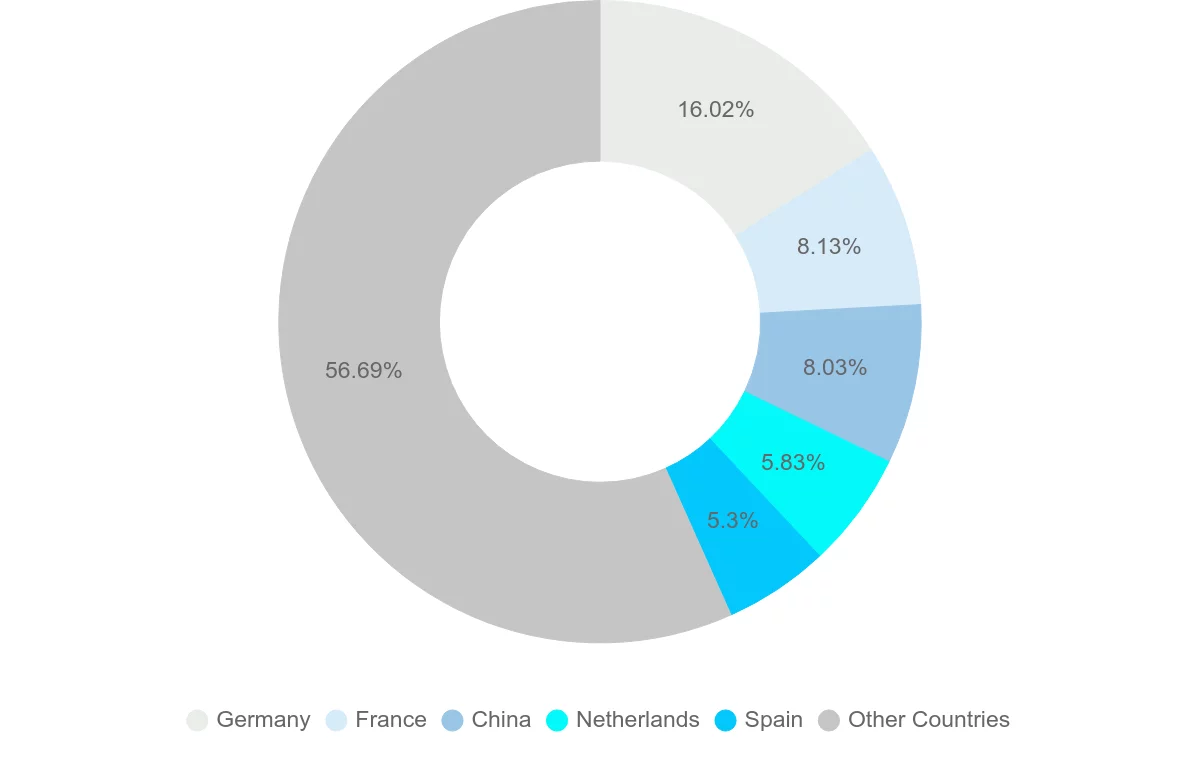 Germany is the largest trade partner for Italy, with a trade volume of $91,042 million, representing 16.02% of Italy's total imports. The key categories of goods imported by Italy from Germany range from machinery and vehicles to chemical products, electronics, and foodstuffs. These imports express the significant role Germany plays in Italy's trade balance, underlining a notable dependence on its European neighbor.
France, the second-largest source of imports for Italy, has a trade volume reported at approximately $46,208 million, accounting for 8.13% of Italy’s total imports. Key import categories include machinery, chemicals, and agricultural products. Following closely behind France is China with a trade volume of $45,627 million, representing 8.03% of Italy's import market. Important import categories from China are mainly textiles, machinery and equipment, footwear, and toys, reflecting the diversity and volume of Chinese goods flowing into the Italian market.
Ranking fourth among Italy's Top 5 Import Partners is the Netherlands, with a trade volume of $33,147 million, accounting for 5.83% of Italy's total imports. Of particular significance are imports of mineral fuels, machinery, pharmaceuticals, and electrical machinery. Lastly, Spain with a trade volume of $30,111 million, contributes 5.3% to Italy's import market. Key imports from Spain include the automotive industry products, food and beverages, and pharmaceuticals. These top 5 import partners collectively play a critical role in shaping Italy's economy and fulfilling its consumptive and production needs.
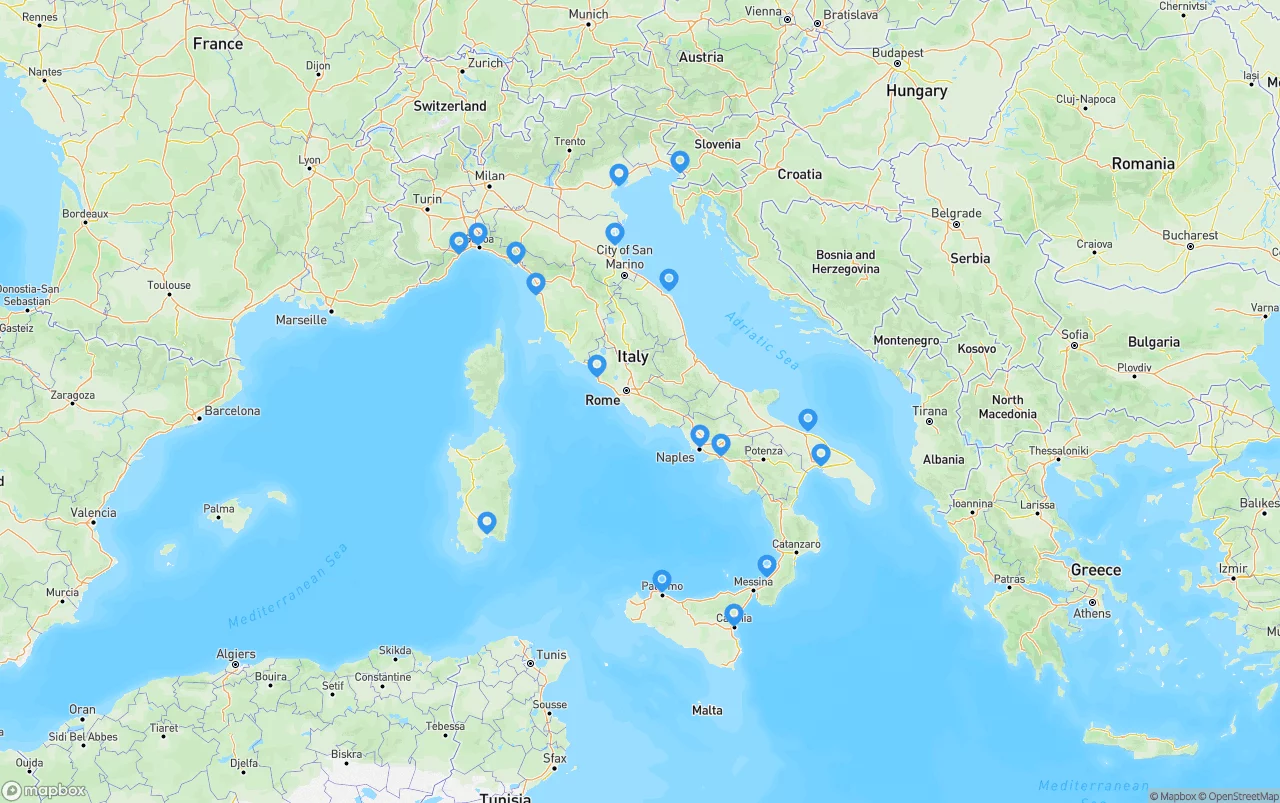 - Genova Port: Located on the northwest coast of Italy, Genova Port is the largest seaport in the country and one of the busiest in the Mediterranean. It serves as a major hub for container shipping, handling a wide range of goods including automobiles, oil, and chemicals.
- Gioia Tauro Port: Situated in Calabria, Gioia Tauro Port is one of the largest container ports in Italy. It is strategically located, making it an important transshipment hub for cargo heading to and from the Mediterranean, Europe, and beyond.
- La Spezia Port: La Spezia Port, located in Liguria, is a key commercial port handling various types of cargo such as containers, dry bulk, and liquid bulk. It is well-connected to major transport networks, making it a popular choice for shipping companies.
- Napoli Port: Napoli Port, located in the south of Italy, is a major gateway for passengers and cargo traveling to and from Southern Europe. It is a significant commercial port, handling goods such as food products, machinery, and textiles.
- Trieste Port: Trieste Port, situated in the northeast of Italy, is a strategic port serving as a gateway to Central and Eastern Europe. It is a major hub for container shipping, Ro-Ro cargo, and bulk commodities, making it a crucial link in the trans-European transport network.
Other notable ports in Italy include Ancona Port, Bari Port, Cagliari Port, Catania Port, Civitavecchia Port, Livorno Port, Palermo Port, Ravenna Port, Salerno Port, Taranto Port, Vado Ligure Port, and Venice Port. Each of these ports plays a vital role in Italy's maritime trade and transportation industry.
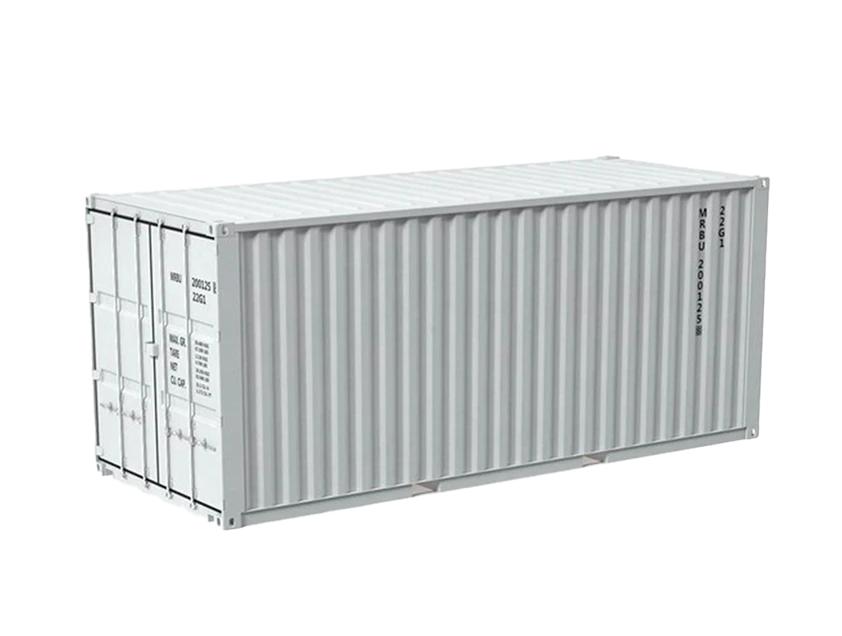
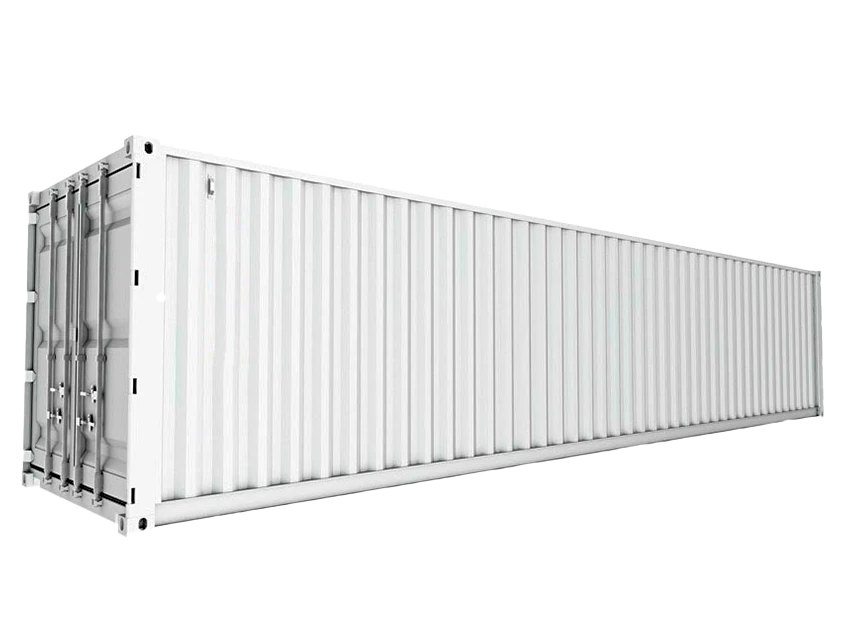
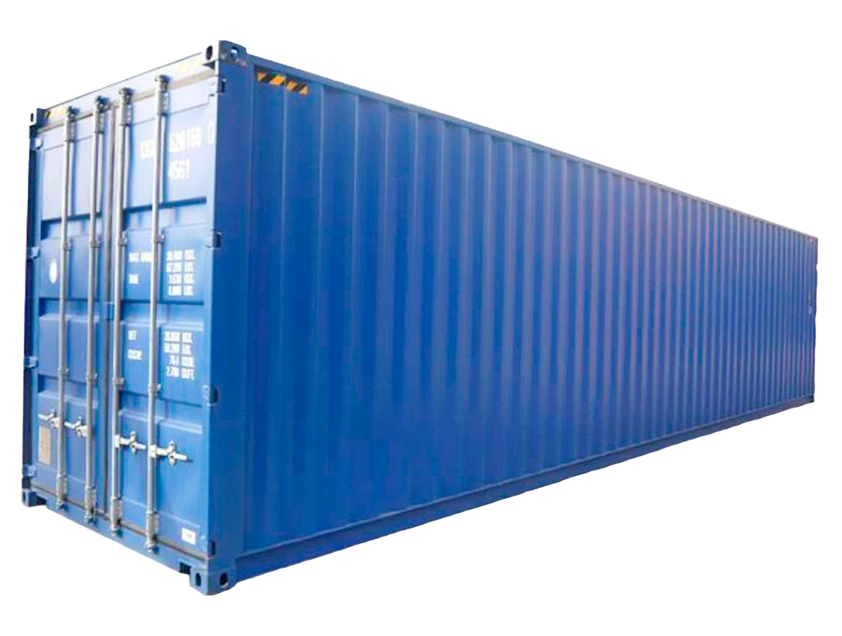
At FWFreight, we offer comprehensive international container shipping services tailored to meet your needs. To Italy, we provide efficient and reliable shipping solutions to destinations worldwide. Here's a breakdown of our shipping options:
LCL (Less than Container Load):
For smaller shipments that don't fill an entire container, our LCL service is the perfect solution. We consolidate multiple shipments into one container, saving you time and money. With regular departures to Italy, your cargo will reach its destination securely and on schedule.
FCL (Full Container Load):
If you have enough cargo to fill a whole container, our FCL service offers exclusive use of a container. This ensures your goods remain secure and minimizes the risk of damage during transit. Choose to 20 FT, 40 FT, or 40 HC containers, depending on the volume and nature of your cargo.
Air Freight:
When time is of the essence, our air freight service provides swift delivery for urgent shipments. With extensive networks and partnerships, we guarantee efficient handling and timely delivery of your cargo to Italy to destinations across the globe.
Looking for a freight forwarder in Italy? There is a list of the best freight forwarders, cargo agents, air, sea, land, river, railroad transport companies, logistics, brokers cargo services in Italy. Elevate your business's supply chain effectiveness by selecting the ideal freight forwarding partner.
Maximize your logistics efficiency by partnering with Italy's premier freight forwarders, uniquely tailored to meet your specific cargo needs. Unlike the one-size-fits-all approach, these expert forwarders invest time to deeply understand your unique shipping requirements. Through a personalized and meticulous approach, they guarantee seamless shipment execution across borders, ensuring timely arrivals at every destination.
Below is a table with shipping rates to Italy for various types of containers from other countries. You can use these Italy Quick Quotes as a guideline. To get an Instant Shipping Rate to Italy for the necessary date, you can send a request.
When planning shipments to Italy from other countries, our company, FWFreight, expertly navigates the key factors involved in the import process. These include understanding the Italian customs and regulations, specialized duties, and the VAT rate which currently stands at 22%. Calculating shipping rates to Italy also involves considering the cost of transport insurance, the value of goods being shipped, and the type of transportation used.
Container transportation to Italy is a common choice for shipping large quantities of goods. This option offers security and cost-effectiveness, especially for heavy or bulky items. However, one must consider the cost of container shipping rates, port charges, and the import duties imposed on the goods. It's also crucial to ensure your cargo complies with the stringent EU regulations to avoid unnecessary delays at the ports.
On the other hand, air transportation to Italy provides a faster delivery option but is typically more expensive. The charge here is based not only on the weight of the goods but also on the dimensional weight. This reflects the package's density and ultimately affects the shipping price. To make air shipping more cost-effective, we recommend consolidating smaller shipments where possible. Our shipping company is well experienced in managing these various factors to ensure the most efficient and affordable import process to Italy.