At FWFreight, we take pride in offering premier freight shipping to the Philippines. Our core services are all-encompassing and designed to cater to each unique requirement in your shipment process. We understand that international shipping to the Philippines from other countries can pose a daunting challenge. However, our vast experience and expertise in managing import to the Philippines put us in a unique position to handle all your logistics requirements. We assure you of competitive pricing, paired with unparalleled service, making your shipping process flexible, secure, and problem-free. With us, you can be confident that you've chosen the reliable partner for your shipping needs.
From our service perspective, FWFreight is committed to providing world-class service to every customer. We provide all-inclusive logistics services encompassing sea, air, rail, and truck transportation, in addition to forwarding services. These offerings are tailored to meet the manifold needs of our diverse clientele, ranging from domestic exporters to global importers. Regardless of the type of transportation, our company ensures the best prices and efficient service to streamline your shipping process. Our dedicated team is always ready to assist you in navigating the complexities of global shipping. With our company, you not just get a shipping aid, but also a trusted partner committed to propelling your business forward.
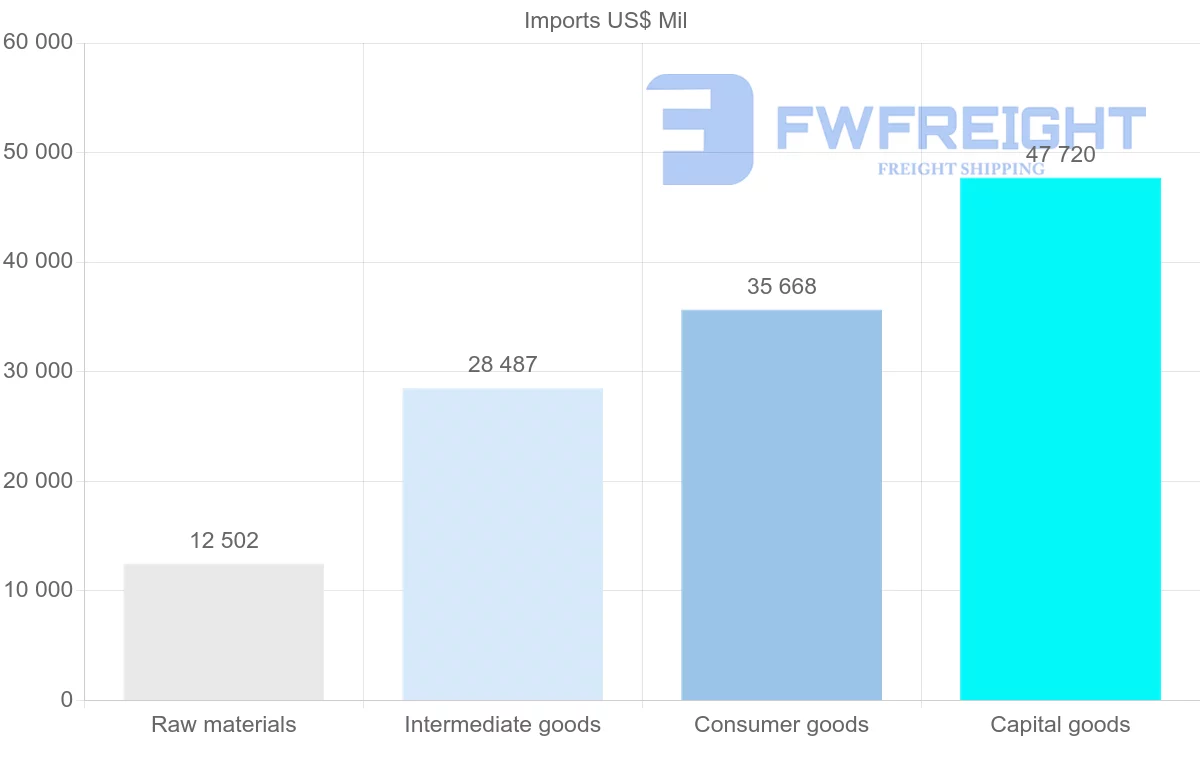 The graph exhibits the distribution of imports across different product categories in the Philippines's top 5 import goods. The categories include raw materials, intermediate goods, consumer goods, and capital goods, all represented in values of US dollars (millions) as well as their share percentage of the total import volume. The 'raw materials' category amounted to 12502 million US dollars equivalent to a 10.05% share. These are goods that are harvested or extracted from the Earth and are used to produce or manufacture finished goods.
Intermediate goods, with an import value of 28487 million US dollars and making up 22.9% of total imports, are goods used in the production of final consumer goods. Consumer goods, with an import volume of 35668 million US dollars, constitute the largest share next to capital goods, accounting for 28.67% of total imports. These are goods bought for consumption by the average consumer. Lastly, 'capital goods' are items used to produce other goods or services, with an import value of 47720 million US dollars, and represented the highest percentage at 38.36% of total imports. The graph underscores the significant contribution of each category to the total import volume, showing the diverse range of imported goods in the Philippines.
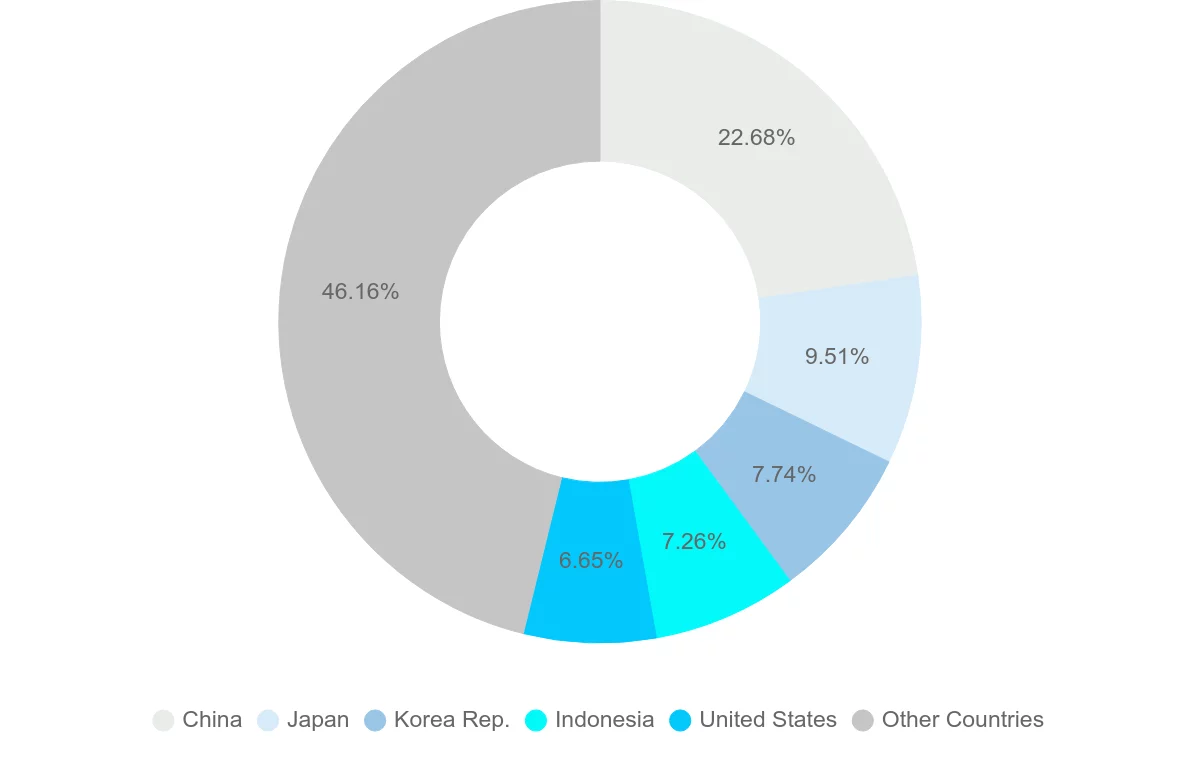 China leads the pack as the top import partner of the Philippines with a trade volume worth US $28,210 million, accounting for 22.68% of the country's total imports. Main import commodities from China primarily include electronic equipment, machinery, iron, and steel. China's dominance highlights its crucial role in the Philippines's supply chain, providing a significant portion of the country's demand for varied goods.
Japan comes in as the second largest import partner with a trade volume of US $11,832 million, comprising 9.51% of total imports. Products from Japan are largely vehicles, machinery, medical and technical equipment. The Republic of Korea stands third, contributing US $9,630 million or 7.74% of total imports to the Philippines. The import from Korea is majorly composed of electronic equipment, machinery, and vehicles. Indonesia is the fourth largest import partner contributing 7.26% of total import shares, which equates to a lump sum of US $9,030 million. The Philippines mainly imports coal, petroleum gases, and palm oil from Indonesia. Lastly, the United States contributes US $8,278 million accounting for 6.65% of total imports. The US primarily exports electronic equipment, machinery, and cereals to the Philippines.
In summary, the aforementioned countries form the Philippines's Top 5 Import Partners. They supply the vast majority of goods needed to sustain the country's varied industries. These partnerships highlight the interconnectedness of today's global economy, where a nation's supply chain can span multiple countries and continents.
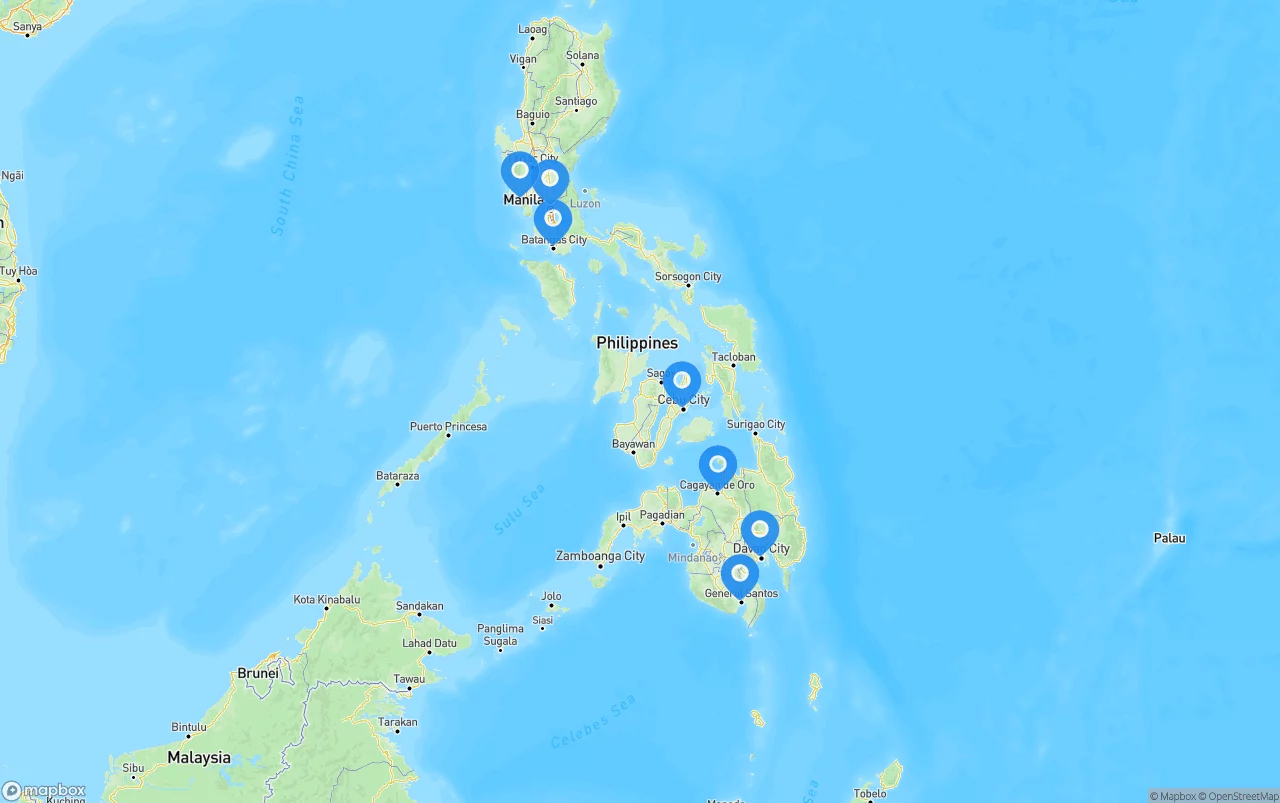 - Manila Port: Manila Port is the largest and busiest port in the Philippines, located in the capital city of Manila. It serves as the main gateway for international trade in the country, handling a wide range of cargo including containers, bulk, and breakbulk. The port is equipped with modern facilities and infrastructure to accommodate large vessels.
- Cebu City Port: Cebu City Port is a major seaport located in the central Visayas region of the Philippines. It is an important hub for domestic shipping and also handles some international cargo. The port plays a key role in connecting the different islands of the Philippines through ferry services.
- Davao Port: Davao Port is the main port serving the southern island of Mindanao. It is a strategic gateway for trade in the region, handling a variety of cargo including agricultural products, minerals, and general goods. The port is well-equipped to handle containerized cargo and bulk shipments.
- General Santos Port: General Santos Port is another key port located in Mindanao, specifically in the city of General Santos. The port primarily handles exports of agricultural products such as bananas, pineapples, and tuna. It is an important economic center for the region and plays a vital role in the country's trade.
- Subic Bay Port: Subic Bay Port is a former US naval base that has been converted into a major commercial port. It is strategically located near Manila and serves as an alternative to the congested Manila Port. The port is known for its modern facilities and efficient operations, particularly in handling containerized cargo.
- Other ports in the Philippines include Batangas Port in Luzon, Luzon Port in the northern region, Cagayan De Oro Port in Mindanao. These ports also play important roles in the country's maritime trade, catering to various types of cargo and vessels.
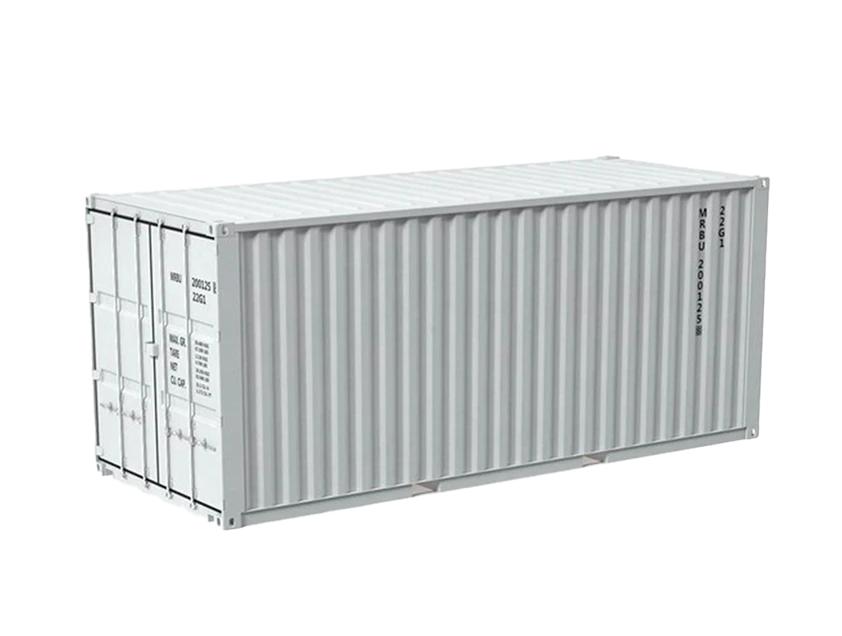
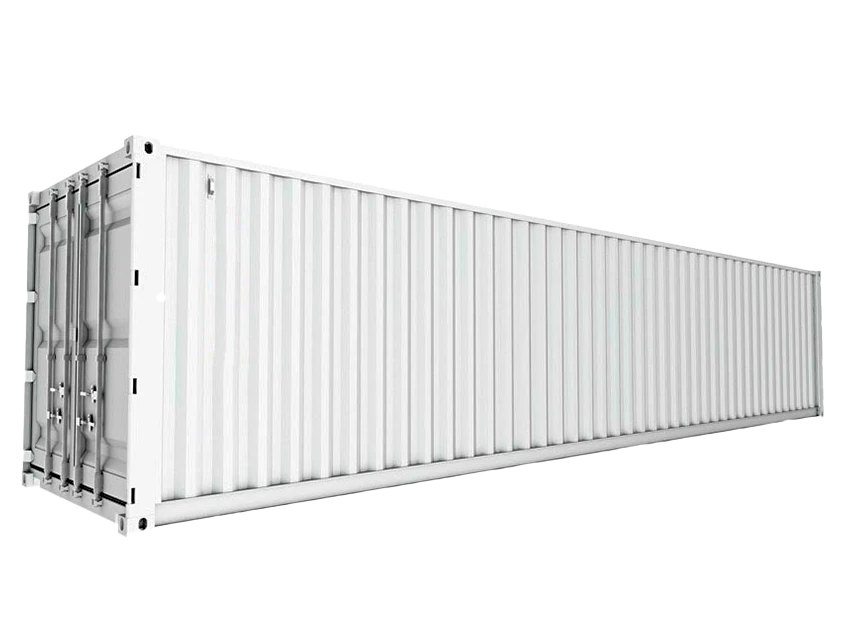
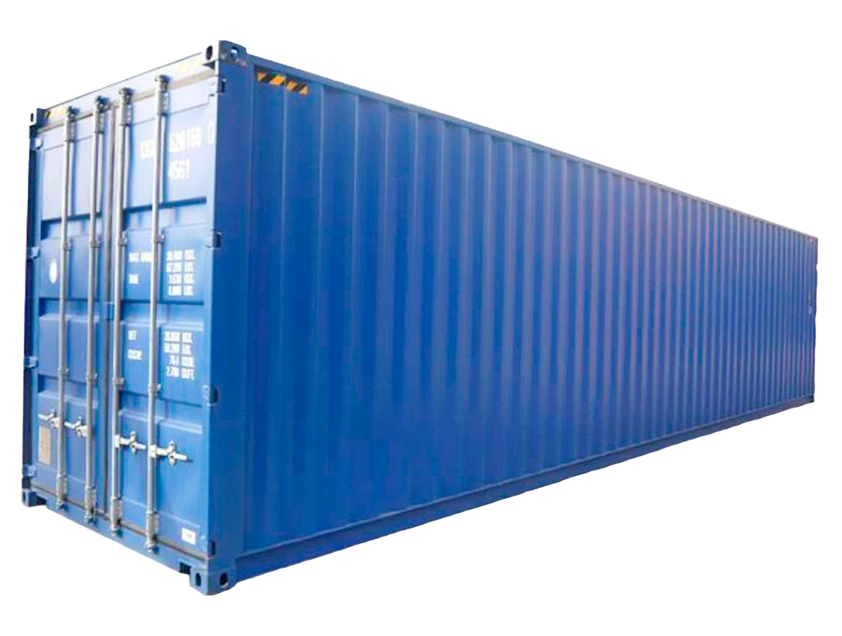
At FWFreight, we offer comprehensive international container shipping services tailored to meet your needs. To Philippines, we provide efficient and reliable shipping solutions to destinations worldwide. Here's a breakdown of our shipping options:
LCL (Less than Container Load):
For smaller shipments that don't fill an entire container, our LCL service is the perfect solution. We consolidate multiple shipments into one container, saving you time and money. With regular departures to Philippines, your cargo will reach its destination securely and on schedule.
FCL (Full Container Load):
If you have enough cargo to fill a whole container, our FCL service offers exclusive use of a container. This ensures your goods remain secure and minimizes the risk of damage during transit. Choose to 20 FT, 40 FT, or 40 HC containers, depending on the volume and nature of your cargo.
Air Freight:
When time is of the essence, our air freight service provides swift delivery for urgent shipments. With extensive networks and partnerships, we guarantee efficient handling and timely delivery of your cargo to Philippines to destinations across the globe.
Looking for a freight forwarder in Philippines? There is a list of the best freight forwarders, cargo agents, air, sea, land, river, railroad transport companies, logistics, brokers cargo services in Philippines. Elevate your business's supply chain effectiveness by selecting the ideal freight forwarding partner.
Maximize your logistics efficiency by partnering with Philippines's premier freight forwarders, uniquely tailored to meet your specific cargo needs. Unlike the one-size-fits-all approach, these expert forwarders invest time to deeply understand your unique shipping requirements. Through a personalized and meticulous approach, they guarantee seamless shipment execution across borders, ensuring timely arrivals at every destination.
Below is a table with shipping rates to Philippines for various types of containers from other countries. You can use these Philippines Quick Quotes as a guideline. To get an Instant Shipping Rate to Philippines for the necessary date, you can send a request.
Importing goods to the Philippines involves detailed logistics planning, comprehensive knowledge of customs regulations, and careful calculation of shipping rates. Our company, FWFreight, specializes in arranging smooth imports to the Philippines from various countries, ensuring compliance with the specialized duties imposed by Filipino customs authorities. We also monitor changes to these duties and help clients navigate the nation's customs law to avoid possible complications and delays.
For container transportation to the Philippines, certain considerations must be taken into account. The selection of a suitable container size, consolidation of goods, and optimal routing all contribute to the cost-effectiveness of shipping. We provide full container load (FCL) and less than a container load (LCL) solutions, tailoring our services to meet the specific requirements of each shipment. Importantly, our meticulous planning and attention to detail enable us to avoid any complications during the customs clearance process.
When it comes to air transportation to the Philippines, the speed and efficiency come at a higher cost than sea shipping. Therefore, it is crucial to evaluate the urgency of the shipment against the budget constraints. We offer door-to-door, airport-to-airport, and door-to-airport services, ensuring the quickest possible delivery times while adhering to international air freight regulations. As part of our service, we conduct thorough checks of all paperwork and documentation, ensuring the accurate calculation of 'Shipping Rates to Philippines' to avoid unexpected costs and delays.